Bad Yet Beautiful by Josh Palumbo, Forest Management Coordinator.
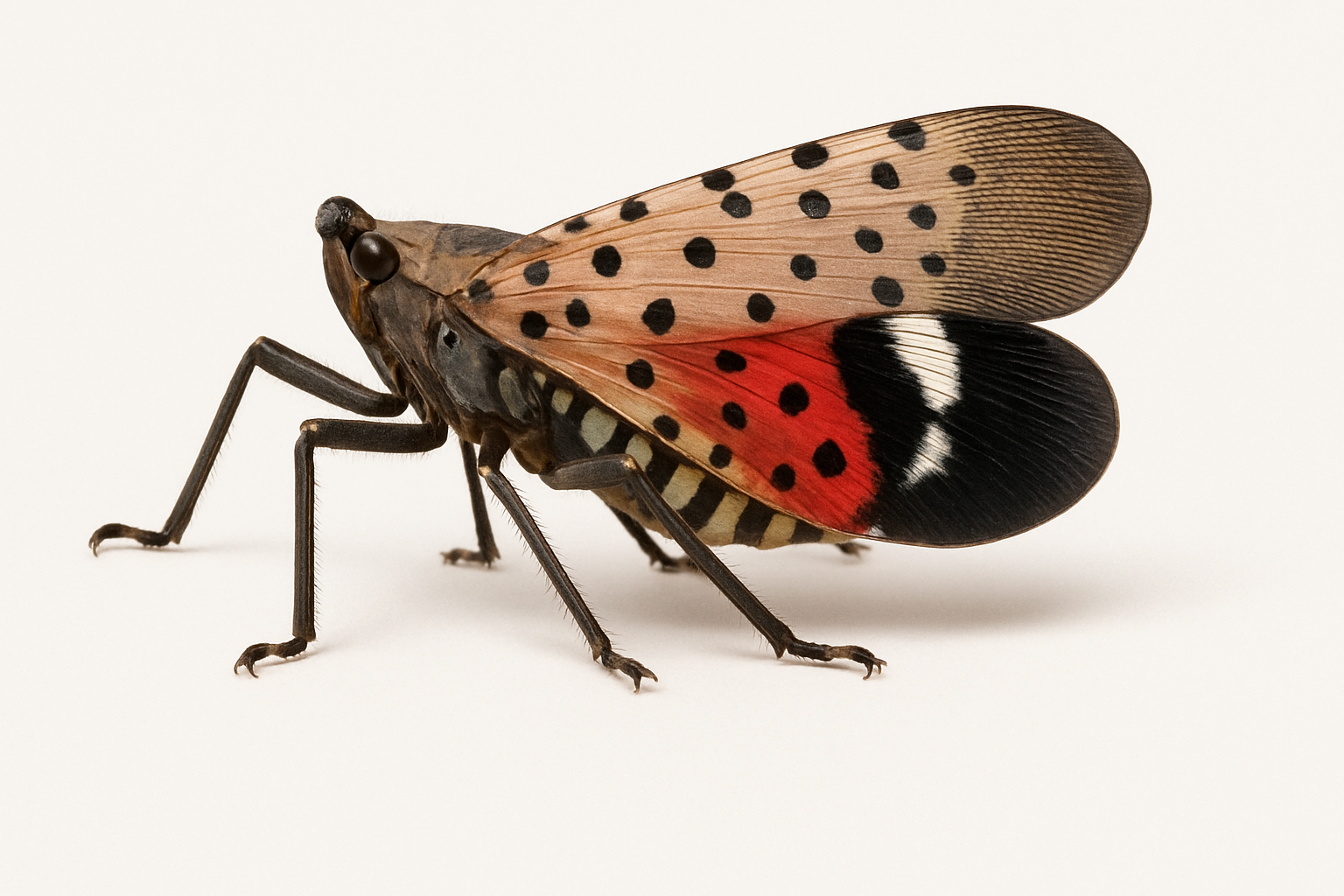
It really is hard to dislike that which is beautiful. The exquisite trillium, the eye-popping bluebird and the stunning brook trout all hold a special place in my mind due to their beauty. A new invasive has made in-roads into Virginia over the past couple years that is certainly beautiful but will not hold that special place in my mind.The spotted lanternfly is quite gorgeous, but is not a welcome addition to our ecosystem. This edition of the Nine Minute Naturalist will go into what this newcomer means for Wintergreen.
The spotted lanternfly is a plant hopper insect native to China, Bangladesh, and Vietnam. It was first found in the U.S. in Berks County Pennsylvania. It was discovered in 2014 but is believed to have arrived via egg masses attached to a stone shipment in 2012. Despite a quick quarantine for the surrounding area, the invasive bug has spread to New Jersey, New York, Rhode Island, Ohio, Maryland and of course Virginia.
They are not dynamic flyers but are adapt at hitchhiking their way around the east coast. Each egg mass is about one inch long, mud colored and can hold 30-50 eggs. They can stick to almost any solid surface and are the reason for the spread of this invasive. This pest found its way into Clarke County Virginia in 2018. The first spotted lanternfly was found in a train depot, having hitchhiked from the northeast. We went from 1 square mile of infestation in 2018 to 60 square miles in 2020.
The attractiveness of this pest makes it quite easy to identify. The adults are approximately 1 inch long and ½ inch wide at rest. The forewing is gray with black spots of varying sizes and the hind wings have patches of red and black with a white band. The abdomen is yellow with black bands. The early stages (1-3 instar) are black with white spots. (Instar is a phase between two periods of molting in the development of an insect.).The last immature stage is characterized by the development of red patches in addition to the black color with white spots. They are quite visually striking but you won’t be seduced by their beauty for long.
A key component of this pest to identify is the egg mass. They are laid in late summer through early fall. They are 1 – 2 inches long colored grey or brown. They are laid on trees or structures near feeding sites but the problem is that few are laid in reach. Most are laid higher in the canopy or manmade structures. All egg masses within reach should be scraped off and smashed.
The spotted lanternfly is a serious threat to farmers. It shows a strong preference for grapevines, hops, and fruit trees such as peach, apple, and cherry.. They also show an affinity for maple, birch, black walnut, and willow. This pest uses its piercing-sucking mouthpart to feed on the sap from over 70 different species. As it feeds, it extracts honeydew which attracts bees, wasps and other insects as well as promotes the growth of sooty mold, which covers the plant, the forest floor, furniture, cars or anything else below the feeding insects. There is a unique link between the insect and another non-native, tree of heaven. Both species are native to China and have been reunited in the United States. Tree of heaven is the preferred host of spotted lanternfly and is commonly found near all the primary travel corridors.
The impact of this new invasive to the Wintergreen environment will be different from our last invasive, the emerald ash borer. Emerald ash borer is hardly seen but brings quick death to just ash trees. The spotted lanternfly attacks a wide variety of species but doesn’t tend to kill a tree outright. This species tends to be a stressor that can certainly bring about weakening for healthy trees and death for failing trees. The biggest impact we will have if this insect establishes at Wintergreen is from a nuisance level. These pests reproduce in volume and become a disgusting annoyance at the landowner level. Reports from Pennsylvania indicate the sudden increase in volume of bugs is very detrimental to enjoying your outdoor living space. Cars, patios and plants quickly get covered in honeydew and sooty mold making them loathsome to homeowners.
The spotted lanternfly is here to stay and will continue its population climb over the next few years. The goal is to mitigate the impact and population. We are past the point when killing individuals will have population impact. A better impact would be to find their egg cases on houses, decks, trees, and rocks and eliminate them. Another precaution would be to remove their favorite host, tree of heaven. If you have any on your property, it is a good idea to make them disappear over the next couple years. Eliminating one non-native so you don’t encourage another non-native is a win/win for our environment.